what are some adaptations that large unicellular organisms have to help diffusion efficiency
The Respiratory Organization and Straight Diffusion
Respiratory processes that aid organisms exchange O2 and CO2 range from simple direct diffusion to circuitous respiratory systems.
Learning Objectives
Review an overview of the functions of the respiratory organisation
Cardinal Takeaways
Cardinal Points
- Respiration ensures that cells, tissues, and major organs of the torso receive an adequate supply of oxygen and that the carbon dioxide, a waste material product, is efficiently removed; the substitution of oxygen and carbon dioxide occurs via diffusion across cell membranes.
- The mechanisms, processes, and structures used for respiration are dictated past the type, size, and complexity of the organism.
- Direct diffusion of gases through the outer membranes tin exist used past organisms such as flatworms as a ways of respiration due to their pocket-sized size and simplicity.
Key Terms
- deoxygenated: having removed the oxygen atoms from a molecule
- diffusion: The passive movement of a solute across a permeable membrane
- aerobic: living or occurring only in the presence of oxygen
Introduction
Animate is an involuntary result. How often a breath is taken and how much air is inhaled or exhaled are tightly regulated by the respiratory centre in the brain. Under normal animate conditions, humans volition breathe approximately 15 times per infinitesimal on average. A respiratory cycle consists of an inhalation and an exhalation: with every normal inhalation, oxygenated air fills the lungs, while with every exhalation, deoxygenated air rushes dorsum out. The oxygenated air crosses the lung tissue, enters the bloodstream, and travels to organs and tissues. Oxygen (Oii) enters the cells where it is used for metabolic reactions that produce ATP, a high-energy compound. At the aforementioned fourth dimension, these reactions release carbon dioxide (CO2) as a by-production. COtwo is toxic and must be eliminated; thus, COtwo exits the cells, enters the bloodstream, travels back to the lungs, and is expired out of the body during exhalation.
The master function of the respiratory organisation is to evangelize oxygen to the cells of the body's tissues and remove carbon dioxide. The main structures of the human being respiratory arrangement are the nasal crenel, the trachea, and the lungs. All aerobic organisms require oxygen to acquit out their metabolic functions.
Along the evolutionary tree, dissimilar organisms accept devised dissimilar means of obtaining oxygen from the surrounding temper. The environment in which the beast lives greatly determines how an brute respires. The complexity of the respiratory system correlates with the size of the organism. As creature size increases, diffusion distances increment and the ratio of expanse to volume drops. In unicellular (unmarried-celled) organisms, diffusion across the cell membrane is sufficient for supplying oxygen to the cell. Diffusion is a slow, passive transport process. In order to be a feasible means of providing oxygen to the cell, the rate of oxygen uptake must match the rate of improvidence across the membrane. In other words, if the cell were very large or thick, diffusion would non be able to provide oxygen rapidly enough to the inside of the cell. Therefore, dependence on diffusion as a means of obtaining oxygen and removing carbon dioxide remains feasible only for small organisms or those with highly-flattened bodies, such as flatworms (platyhelminthes). Larger organisms have had to evolve specialized respiratory tissues, such as gills, lungs, and respiratory passages, accompanied by a circuitous circulatory arrangement to transport oxygen throughout their entire body.

Direct diffusion: This flatworm's procedure of respiration works by diffusion across the outer membrane.
Direct Diffusion
For pocket-sized multicellular organisms, improvidence across the outer membrane is sufficient to meet their oxygen needs. Gas exchange by straight improvidence across surface membranes is efficient for organisms less than 1 mm in bore. In unproblematic organisms, such as cnidarians and flatworms, every cell in the torso is close to the external environment. Their cells are kept moist so that gases lengthened quickly via straight diffusion. Flatworms are small, literally flat worms, which 'breathe' through improvidence across the outer membrane. The flat shape of these organisms increases the surface surface area for diffusion, ensuring that each cell within the body is close to the outer membrane surface and has access to oxygen. If the flatworm had a cylindrical body, so the cells in the center would not be able to become oxygen.
Skin, Gills, and Tracheal Systems
Respiration can occur using a multifariousness of respiratory organs in different animals, including skin, gills, and tracheal systems.
Learning Objectives
Describe how the skin, gills, and tracheal system are used in the procedure of respiration
Key Takeaways
Primal Points
- Some animals, such every bit amphibians and earthworms, can use their peel (integument) to commutation gases betwixt the external environment and the circulatory system due to the network of capillaries that lie beneath the pare.
- Fish and other aquatic organisms employ gills to have up oxygen dissolved in the water and diffuse carbon dioxide out of the bloodstream.
- Some insects utilize a tracheal arrangement that transports oxygen from the external environment through openings chosen spiracles.
Cardinal Terms
- coelom: a fluid-filled cavity inside the torso of an fauna; the digestive organisation is suspended within the crenel, which is lined by a tissue chosen the peritoneum
- gill: a breathing organ of fish and other aquatic animals
- spiracle: a pore or opening used (especially by spiders and some fish) for breathing
Peel and Gills
In that location are various methods of gas exchange used past animals. Every bit seen in mammals, air is taken in from the external environment to the lungs. Other animals, such every bit earthworms and amphibians, apply their skin (integument) every bit a respiratory organ. A dense network of capillaries lies just beneath the skin, facilitating gas substitution between the external surround and the circulatory system. The respiratory surface must be kept moist in order for the gases to deliquesce and diffuse beyond jail cell membranes.
Organisms that alive in h2o also need a way to obtain oxygen. Oxygen dissolves in h2o, merely at a lower concentration in comparison to the atmosphere, which has roughly 21 percent oxygen. Fish and many other aquatic organisms have evolved gills to have up the dissolved oxygen from water. Gills are sparse tissue filaments that are highly branched and folded. When water passes over the gills, the dissolved oxygen in the h2o rapidly diffuses across the gills into the bloodstream. The circulatory system tin so comport the oxygenated blood to the other parts of the body. In animals that contain coelomic fluid instead of claret, oxygen diffuses across the gill surfaces into the coelomic fluid. Gills are found in mollusks, annelids, and crustaceans.

Common carp: This common bother, like many other aquatic organisms, has gills that allow it to obtain oxygen from water.
The folded surfaces of the gills provide a big surface surface area to ensure that fish obtain sufficient oxygen. Diffusion is a procedure in which cloth travels from regions of high concentration to depression concentration until equilibrium is reached. In this case, blood with a depression concentration of oxygen molecules circulates through the gills. The concentration of oxygen molecules in water is higher than the concentration of oxygen molecules in gills. As a result, oxygen molecules diffuse from water (loftier concentration) to blood (low concentration). Similarly, carbon dioxide molecules diffuse from the claret (high concentration) to water (low concentration).

Oxygen transport and gills: As water flows over the gills, oxygen is transferred to blood via the veins.
Tracheal Systems
Insect respiration is independent of its circulatory system; therefore, the blood does not play a direct role in oxygen transport. Insects have a highly-specialized type of respiratory system chosen the tracheal organization, which consists of a network of pocket-size tubes that carries oxygen to the unabridged body. The tracheal system, the nearly direct and efficient respiratory system in active animals, has tubes made of a polymeric material called chitin.
Insect bodies have openings, called spiracles, forth the thorax and abdomen. These openings connect to the tubular network, assuasive oxygen to pass into the body, regulating the diffusion of COtwo and water vapor. Air enters and leaves the tracheal system through the spiracles. Some insects tin can ventilate the tracheal system with body movements.

Insect respiration: Insects perform respiration via a tracheal organization, in which openings called spiracles allow oxygen to laissez passer into the trunk.
Amphibian and Bird Respiratory Systems
Birds and amphibians take different oxygen requirements than mammals, and as a result, different respiratory systems.
Learning Objectives
Differentiate amongst the types of breathing in amphibians and birds
Primal Takeaways
Key Points
- Amphibians utilize gills for breathing early in life, and develop primitive lungs in their developed life; additionally, they are able to breathe through their peel.
- Birds have evolved a directional respiratory arrangement that allows them to obtain oxygen at loftier altitudes: air flows in one direction while blood flows in another, assuasive efficient gas exchange.
Key Terms
- gills: A breathing organ of fish, amphibians, and other aquatic animals.
Amphibian Respiration
Amphibians accept evolved multiple ways of breathing. Young amphibians, similar tadpoles, utilise gills to breathe, and they do not go out the water. As the tadpole grows, the gills disappear and lungs grow (though some amphibians retain gills for life). These lungs are primitive and are non as evolved every bit mammalian lungs. Adult amphibians are lacking or have a reduced diaphragm, so breathing through the lungs is forced. The other means of breathing for amphibians is diffusion beyond the peel. To assist this improvidence, amphibian skin must remain moist. Information technology has vascular tissues to make this gaseous exchange possible. This moist pare interface can be a detriment on land, but works well under water.
Avian Respiration
Birds are dissimilar from other vertebrates, with birds having relatively small lungs and ix air sacs that play an of import office in respiration. The lungs of birds also do non have the capacity to inflate every bit birds lack a diaphragm and a pleural crenel. Gas substitution in birds occurs between air capillaries and blood capillaries, rather than in alveoli.
Flying poses a unique claiming with respect to breathing. Flying consumes a peachy amount of energy; therefore, birds require a lot of oxygen to aid their metabolic processes. Birds have evolved a respiratory system that supplies them with the oxygen needed to sustain flight. Similar to mammals, birds have lungs, which are organs specialized for gas exchange. Oxygenated air, taken in during inhalation, diffuses across the surface of the lungs into the bloodstream, and carbon dioxide diffuses from the claret into the lungs, and is then expelled during exhalation. The details of breathing between birds and mammals differ essentially.

Bird Respiration: The procedure of inhalation and exhalation in birds. 3 singled-out sets of organs perform respiration — the inductive air sacs, the lungs, and the posterior air sacs.
In addition to lungs, birds accept air sacs inside their torso. Air flows in one direction from the posterior air sacs to the lungs and out of the anterior air sacs. The period of air is in the opposite direction from blood menstruum, and gas exchange takes identify much more than efficiently. This type of breathing enables birds to obtain the requisite oxygen, even at higher altitudes where the oxygen concentration is low. This directionality of airflow requires two cycles of air intake and exhalation to completely become the air out of the lungs.
Mammalian Systems and Protective Mechanisms
The mammalian respiratory organization equilibrates air to the body, protects against foreign materials, and allows for gas exchange.
Learning Objectives
Explain how air passes from the outside surroundings to the lungs, protecting them from particulate thing
Primal Takeaways
Key Points
- The air that moves from the external environment into the body must pass through the nasal cavity where information technology is warmed, humidified, and surveyed for particulates.
- As air moves out of the nasal cavity, it moves into the throat, larynx, trachea, the master bronchi (right and left lung), secondary and tertiary bronchi, bronchioles, terminal and then respiratory bronchioles, alveolar ducts and then alveolar sacs where gas commutation occurs with the capillaries.
- Components in the respiratory arrangement allow for protection from foreign cloth; these include mucus production in the lungs and cilia in the bronchi and bronchioles to movement thing out of the organisation.
- Components in the respiratory system that allow for protection from strange material and include mucus production in the lungs and cilia in the bronchi and bronchioles.
Key Terms
- alveolus: a small air sac in the lungs, where oxygen and carbon dioxide are exchanged with the claret
- bifurcate: to divide or fork into two channels or branches
- bronchus: either of ii airways, which are primary branches of the trachea, leading direct into the lungs
Mammalian Respiratory System
In mammals, pulmonary ventilation occurs via inhalation when air enters the body through the nasal crenel. Air passes through the nasal cavity and is warmed to body temperature and humidified. The respiratory tract is coated with mucus that is loftier in water to seal the tissues from direct contact with air. As air crosses the surfaces of the mucous membranes, it picks up water. This equilibrates the air to the body, reducing damage that common cold, dry air can cause. Particulates in the air are too removed in the nasal passages. These processes are all protective mechanisms that prevent damage to the trachea and lungs.
From the nasal cavity, air passes through the pharynx and the larynx to the trachea. The office of the trachea is to funnel the inhaled air to the lungs and the exhaled air out of the body. The human trachea, a cylinder about 10-12cm long, 2cm in diameter establish in front of the esophagus, extends from the larynx into the breast cavity. It is made of incomplete rings of hyaline cartilage and smooth muscle that divides into the two principal bronchi at the midthorax. The trachea is lined with fungus-producing goblet cells and ciliated epithelia that propel foreign particles trapped in the mucus toward the pharynx. The cartilage provides force and support to the trachea to continue the passage open. The smooth muscle tin can contract, causing a decrease in the trachea's diameter, which propels expired air up from the lungs at a great force. The forced exhalation helps expel mucus when we cough.

Trachea and bronchi structure: The trachea and bronchi are made of incomplete rings of cartilage.

Road of inhalation: Air enters the respiratory organisation through the nasal cavity and throat. It then passes through the trachea and into the bronchi, which bring air into the lungs.
Lungs: Bronchi and Alveoli
The end of the trachea bifurcates to the correct and left lungs, which are non identical. The larger right lung has iii lobes, while the smaller left lung has two lobes. The muscular diaphragm, which facilitates animate, is inferior to the lungs, marking the end of the thoracic cavity.
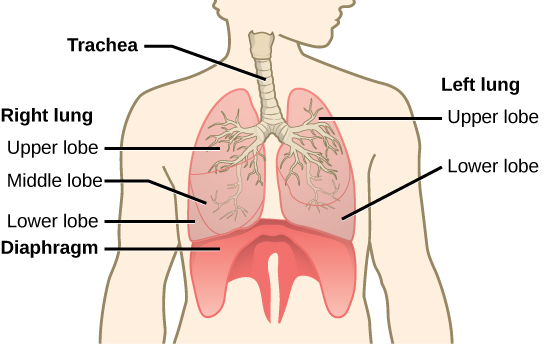
Lung structure: The trachea bifurcates into the right and left bronchi in the lungs. The larger right lung is made of three lobes. To accommodate the center, the left lung is smaller, having only two lobes.
Equally air enters the lungs, information technology is diverted through bronchi start with the two primary bronchi. Each bronchus divides into secondary, and so into tertiary bronchi, which further dissever to create smaller bore bronchioles that separate and spread through the lung. The bronchi are made of cartilage and polish muscle; at the bronchioles, the cartilage is replaced with rubberband fibers. Bronchi are innervated by fretfulness of both the parasympathetic and sympathetic nervous systems that control muscle contraction or relaxation, respectively. In humans, bronchioles with a bore smaller than 0.5 mm are the respiratory bronchioles. Since they lack cartilage, they rely on inhaled air to support their shape. As the passageways decrease in diameter, the relative amount of smooth muscle increases.
The concluding bronchioles then subdivide into respiratory bronchioles which subdivide into alveolar ducts. Numerous alveoli (sing. air sac) and alveolar sacs surround the alveolar ducts. The alveolar ducts are attached to the end of each bronchiole; each duct ends in approximately 100 alveolar sacs. Each sac contains 20-thirty alveoli that are 200-300 microns in diameter. Alveoli are made of sparse-walled, parenchymal cells that are in direct contact with capillaries of the circulatory system. This ensures that oxygen will diffuse from alveoli into the blood and that carbon dioxide produced past cells as a waste production will diffuse from the blood into alveoli to be exhaled. The anatomical arrangement of capillaries and alveoli emphasizes the human relationship of the respiratory and circulatory systems. Equally there are so many alveoli (around 300 million per lung) inside each alveolar sac so many sacs at the end of each alveolar duct, the lungs accept a sponge-like consistency. This organization produces a very large surface area that is available for gas substitution.

Alveolar construction: Final bronchioles are connected past respiratory bronchioles to alveolar ducts and alveolar sacs. Each alveolar sac contains 20 to thirty spherical alveoli and has the appearance of a bunch of grapes. Air flows into the atrium of the alveolar sac, then circulates into alveoli where gas exchange occurs with the capillaries. Fungus glands secrete fungus into the airways, keeping them moist and flexible.
Protective Mechanisms
The air that organisms breathe contains particulate matter such as dust, clay, viral particles, and bacteria that tin damage the lungs. The respiratory system has protective mechanisms to avoid damage. In the nasal crenel, hairs and mucus trap small-scale particles, viruses, leaner, dust, and clay to foreclose entry. If particulates make information technology beyond the nose or enter via the mouth, the bronchi and bronchioles contain several protective devices. The lungs produce mucus that traps particulates. The bronchi and bronchioles contain cilia, small hair-similar projections that line the walls of the bronchi and bronchioles. These cilia motility fungus and particles out of the bronchi and bronchioles support to the throat where information technology is swallowed and eliminated via the esophagus.

Electron microscope paradigm of cilia: The bronchi and bronchioles contain cilia that help move mucus and other particles out of the lungs.
In humans, tar and other substances in cigarette smoke destroy or paralyze the cilia, making the removal of particles more difficult. In add-on, smoking causes the lungs to produce more fungus, which the damaged cilia are unable to move. This causes a persistent cough, as the lungs try to rid themselves of particulate thing, making smokers more than susceptible to respiratory ailments.
saundersproppracted.blogspot.com
Source: https://courses.lumenlearning.com/boundless-biology/chapter/systems-of-gas-exchange/
0 Response to "what are some adaptations that large unicellular organisms have to help diffusion efficiency"
Post a Comment