Pew Research Center Baby Boomers and Millennials Definition
America's baby boomers are in a collective funk. Members of the big generation born from 1946 to 1964 are more downbeat well-nigh their lives than are adults who are younger or older, co-ordinate to a new Pew Research Center Social and Demographic Trends survey.
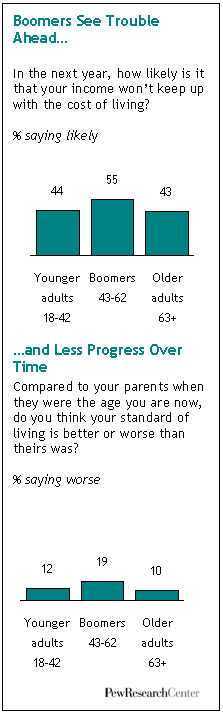 Not simply practise boomers give their overall quality of life a lower rating than adults in other generations, they too are more likely to worry that their incomes won't go along up with inflation — this despite the fact that boomers enjoy the highest incomes of whatsoever age group.
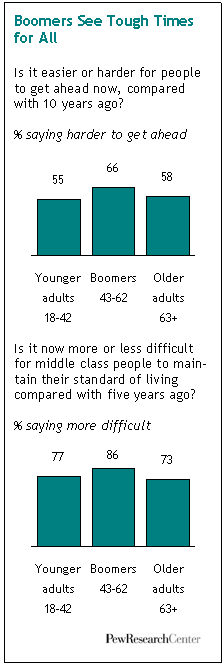
More than and so than those in other generations, boomers believe information technology is harder to get ahead now than it was 10 years ago. And they are less apt than others to say their standard of living exceeds the one their parents had when their parents were the historic period they are now.
These gloomy assessments come from a generation that always has been identified with youth (witness the resilience of their label: "baby boomers") but that'south now well into — and fifty-fifty across — middle age. (Boomers turn 44 to 62 this yr.)
However, information technology is by no means certain that the boomers' electric current bleak mood is a office of their current stage of life. When information technology comes to quality-of-life assessments, data suggest the boomers more often than not accept been downbeat, compared with other age groups, for the past 2 decades — starting back when some were even so in their twenties. And then their current sour ratings may be related to getting older, just they besides may be related to the attitudes and expectations about life they formed when they were young.
The Pew survey was conducted past phone from Jan 24 through Feb xix, 2008 amid a randomly selected nationally representative sample of 2,413 adults. Infant boomers are defined as adults ages 43-62 at the time the survey was taken.
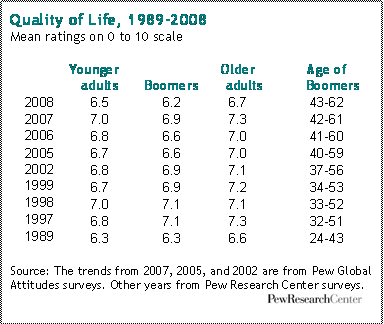
On a question that asked respondents to rate their nowadays life on a scale of naught to x, boomers, on average, give their lives a rating of half-dozen.2. In contrast, adults older than boomers (those who are ages 63 and in a higher place) give their lives an average rating of 6.7. Adults younger than boomers (those who are ages xviii to 41) give their lives an average rating of six.v.
This "quality of life" gap between boomers and non-boomers absolutely is modest. A pattern of gaps, nevertheless, has lasted throughout the two decades the Pew Research Middle has been asking this question, although in some years the differences are also pocket-sized to be statistically significant.
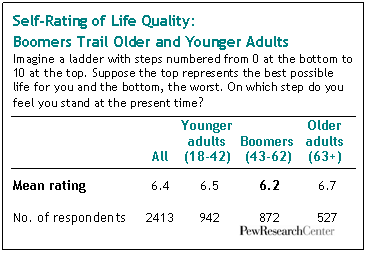
Since 1989 — dorsum when boomers ranged in historic period from 25 through 43 — their self-rankings take trailed those of adults who are older than them. As for adults who are younger than boomers, the blueprint is more mixed. For the past iv years, boomers take too trailed this younger grouping. But in the late 1990s through 2002, boomers gave their lives a slightly better rating than younger adults gave theirs. A table at the stop of this analysis shows the trend in quality of life ratings for each of these age groups since 1989.
 Worried Well-nigh Money
The latest Pew survey finds that the boomers' glum assessments about their lives overall are matched by relatively high levels of anxiety about their personal finances. Some 55% say it is likely that their incomes volition not keep up with the cost of living over the adjacent yr. That bulk makes them the exception among all adults. Simply four-in-ten younger Americans (44%) or older ones (43%) have that business organization.
The anomaly here is that boomers are in their superlative earning years. Every bit a group, they enjoy higher median household incomes than do younger or older adults, according to the Census Bureau'south 2006 American Customs Survey. Americans ages 45 to 64 — roughly the same historic period range as the boomers — have a median household income of nearly $threescore,000. That compares with about $53,000 for adults ages 25 to 44, and most $30,000 for those ages 65 and older.
In the Pew survey, boomers also are more than likely than younger or older adults to own stocks or bonds, and to have retirement accounts.
Yet, boomers are more than anxious than other Americans that they will have to cutting household spending in the coming year considering money is tight. Nearly 3-in-ten boomers (28%) say it is very likely they volition accept to do so, compared with 22% of younger adults and 18% of older ones.
Asked well-nigh changes in their finances over the past year, most boomers (59%) report they had to spend less considering money was tight, but so exercise most younger Americans (58%). By other measures, boomers are less fiscally strained than younger adults. They are less probable (22% to 32%) to say someone in their household had to get to piece of work in the past year or take on an extra chore to make ends meet. They are less likely to say they have had problem paying for medical care (22% to 29%) or for housing (xiii% to 24%). Boomers as well are less likely than younger adults (thirteen% to 19%) to have been laid off in the past year. On the other hand, they also are less likely to accept received a pay raise (43% to 52%).
Progress in Life — Looking Forward and Backward
Asked to compare their standard of living with that of their parents at the same historic period, boomers are more downbeat than younger or older adults. Almost 4-in-x (39%) infant boomers say their standard of living is worse, or no better, than that of their parents. That is a higher proportion than amidst younger adults (32%) or older ones (27%) who say the same thing.
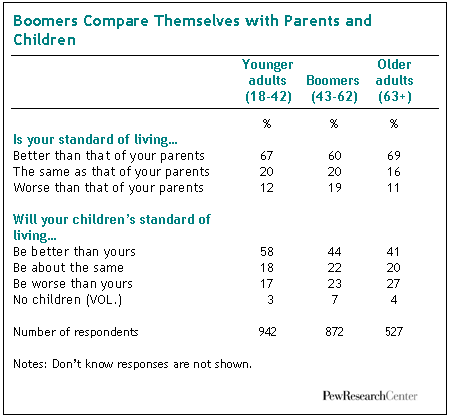
Peering into the time to come, virtually baby boomers do not believe their own children will have a higher standard of living than they do. Only 44% of baby boomers believe their sons and daughters volition exist improve off as adults than they are now. That is about the aforementioned proportion as among older Americans (41%), simply much lower than the 58% of younger Americans who think their children will fare improve than they have.
Information technology'south Not Only Me
 Baby boomers are pessimistic not simply well-nigh their own finances, simply also about anybody else'southward. They are more than probable than younger or older Americans to believe that it is harder to make progress, and easier to lose ground, than it was in the by.
Two-thirds of baby boomers say information technology is harder for people to become alee at present than a decade ago. That is a more downbeat assessment than other age groups give. Amid younger adults, 55% say information technology is harder to go ahead. Among older adults, 58% say and so.
Looking astern, boomers also believe it is easier to fall behind than it was a decade ago: More than than 3-quarters (76%) say and so. On this, they also have bleaker views than other historic period groups. Two-thirds of younger Americans (67%) say information technology is easier to fall behind, as practise 59% of older Americans.
Most Americans say it is more difficult for middle grade people to maintain their standard of living than it was 5 years ago, but baby boomers are peculiarly likely to believe this. A whopping 86% say information technology is harder than it used to exist to proceed upwardly a center course lifestyle, compared with 77% of younger people and 73% of older ones.
Are Older Boomers Unlike From Younger Ones?
The baby boom generation is not monolithic. Ane way that economists and and so
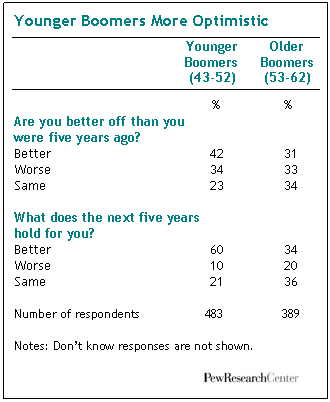
cial scientists await at its differences is to compare younger boomers, ages 43-52, with older ones, ages 53-62. In full general, younger boomers are more optimistic.
To some extent, these differences within the infant blast generation reflect a broader age design in the survey. Younger people are more than probable than older ones to say they take moved up the ladder of life in recent years, or to predict that they will in the near future. But, in i more measure of their gloominess, boomers are as likely as adults who are older than they are to say they have slipped on the ladder of life; a tertiary say and so.
Asked to rank their quality of life on a nothing to 10 scale, boomers dissever themselves fairly evenly among low (0-5), medium (6-vii) and high (8-10) ratings. There is niggling difference between older and younger boomers in current rankings on the so-called ladder of life.
Only amidst younger boomers, four-in-ten (42%) say they have made progress over the past five years. Amid older boomers, merely iii-in-ten (31%) say they have. Older boomers are more likely than younger ones to say they have not budged (34% to 23%). Nearly a tertiary of both groups say they have slipped down the ladder.
Asked where they await to stand up on the ladder of life in five years, virtually younger boomers (60%) predict they volition exist on one of the highest rungs. But 34% of older boomers say so. Looked at another way, lx% of younger boomers believe they volition move upwards the ladder of life over the adjacent 5 years, compared with 34% of older boomers who think so. Older boomers are more likely than younger ones to say they volition be in the aforementioned identify (36% to 21%) or to predict they volition accept moved down (xx% to 10%).
Why And then Glum?
In the cease, these survey data do not say definitively why baby boomers are sour compared with other adults, simply these numbers and other enquiry propose some possibilities. Seven-in-ten boomers say they are dissatisfied with the management in which the country is going, which is considerably higher than the share of younger adults who say so (54%) and about the same as the share of older adults who do (68%). They are more likely than either younger or older adults to agree with the statement that the rich but get richer these days while the poor get poorer.
Intriguingly, younger boomers ally themselves with Americans ages 20-27– the and then-called "Generation Next"– in their tendency to assert that success in life is adamant mainly by exterior forces. Virtually 4-in-ten say and so. Among older boomers and other historic period groups, only well-nigh three-in-x say and so.
Demographically speaking, this is a generation at the height of its earning power, but with a lot on its plate. Most boomers have children to worry nearly, and about have at least one living parent. Three-quarters are homeowners, at a time when home values are stagnant and the mortgage crisis is heating upwards. Boomers are edging toward retirement, which potentially means living on a fixed income. Overall, 17% already are retired, but that proportion rises to 31% among older boomers.
Also, some baby boomers may exist feeling financially stretched because they find themselves in a "sandwich" stage of life — supporting children or aging parents, or sometimes both. A 2005 Pew Research Center survey institute that half of all boomers were raising i or more young children and/or providing primary financial support to one or more adult children. Another 17%, who were parents of children 18 and older, provided some financial support to at least ane adult kid. An additional two-in-10 were providing some financial assist to a parent.
Looking into their financial futures, only 26% of the baby boomers said so that they expected to live very comfortably in retirement. That was a lower per centum than either younger people (37%) or older ones (33%), many of whom already are retired.
On the other hand, another theory is offered past University of Chicago sociologist Yang Yang, who suggests that the huge size of the baby boom generation — 76 million — created more competition for schooling and jobs than smaller generations encountered. This competition, and then the theory goes, creates stress. In a recently published research paper,one she proposed the theory to explicate why iii decades of data from the General Social Survey indicate that boomers have experienced less happiness on average during their lives than younger or older adults.
It's also possible that the seeds of the boomers' discontent were planted long agone — back when they were young and their generation reveled in the culture of youth. Boomers are a big, complicated generation, just one thing can exist said near them without fear of contradiction: They are no longer young.
saundersproppracted.blogspot.com
Source: https://www.pewresearch.org/social-trends/2008/06/25/baby-boomers-the-gloomiest-generation/
0 Response to "Pew Research Center Baby Boomers and Millennials Definition"
Post a Comment